

Do minimum passing distance laws for cyclists change driver behaviour?
Small improvements in passing distance on low speed roads observed after introduction of minimum passing distance laws

PassBox
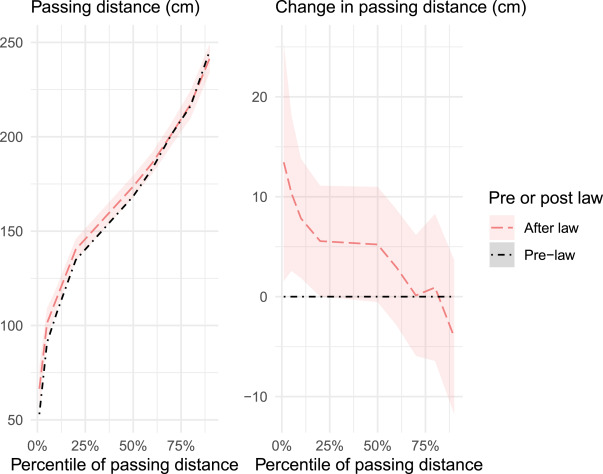
This study investigates the effect of minimum passing distance laws (also called ‘1-metre laws’ or ‘3-foot laws’) on driver behaviour. Passing distances were recorded for 70 cyclists in Perth, Western Australia before and after the introduction of a minimum passing distance law, which coincided with an advertising campaign promoting cyclist safety. The results show only a marginal reduction in the share of passes that were very close to the cyclist on roads with lower speed limits. On these roads, the closest 5% of passes were 10 cm (95% CI [2, 19] cm) further from cyclists after the law and advertising campaign. For higher speed roads, there was no effect. The very small improvement found, limited to slower roads, is considerably smaller than that of other interventions to improve cyclist safety. For instance, protected bicycle lanes have been associated with a 73 cm increase in passing distance — an effect approximately seven times greater than that of the minimum passing distance law.
Read the full article here: Open access article
Citation: James Sinclair, Jonathan Nolan, Do minimum passing distance laws for cyclists change driver behaviour?, Journal of Cycling and Micromobility Research, Volume 7, 2026, 100102, ISSN 2950-1059, https://doi.org/10.1016/j.jcmr.2025.100102.